This article may contain affiliate links. If you buy through them, Decorating Our Space may earn a small commission at no extra cost to you. Learn more.
For two years I lived in a room where my bed was eleven feet from my sofa, close enough that I could see the sheets from the dinner table. That is the reality of a true studio, not the styled version in photographs where the bed is somehow always out of frame. Sleeping and living in the same room is not a design challenge you solve once. It is a set of daily decisions about what the room is being used for at any given hour.
The room needs a closing ritual, not just a layout
Furniture placement matters less than I expected it to. What mattered more was a routine that signaled to my own head when the room had switched from living space to bedroom. I pull one curtain across a tension rod at night, not because it hides the bed from anyone, since I live alone, but because pulling it is a physical action that tells me the day is over. Without that small ritual, I found myself scrolling on my phone in bed at 1 a.m. with the same lights on I used for cooking dinner, because nothing in the room had changed to suggest it was time to stop.
A room that never visually changes between day and night mode makes it harder for the brain to downshift. That is not decorating advice. It is a practical fix for a real problem that comes from asking one room to do two incompatible jobs.
Furniture that separates without walls
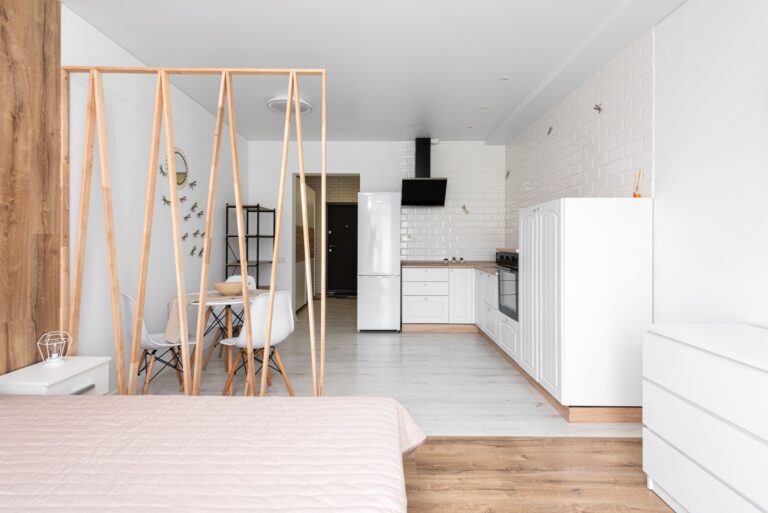
A tension rod and curtain is the cheapest divider that exists, and it does not require drilling into a rented wall. I strung mine across a five foot span between the sleeping nook and the rest of the room, and it cost less than a single throw pillow. It is not soundproof and it is not private from anyone else in the apartment, but it is enough of a visual break that the bed stops being the first thing a guest sees when they walk in.
A bookshelf with a closed back does a similar job during the day and adds storage the curtain cannot. I use both, the curtain at night and the shelf as a permanent divider, because they solve slightly different problems. The curtain is about privacy and ritual. The shelf is about sightlines and storage.
The furniture that never worked
I want to be honest about a failure here, because most articles skip the things that did not pan out. I bought a folding screen with good reviews, expecting it to be the answer to the whole problem. It fell over twice in the first month, took up floor space when folded and stored against the wall, and looked cheap within a few weeks despite not being cheap. I sold it at a loss. A tension rod curtain, which cost a tenth of the price, did the job better because it did not need floor space of its own when not in use.
A divider that needs its own storage space when not dividing anything has added a second problem to solve the first one.
A daybed instead of a sofa
My current setup uses a daybed against the wall instead of a separate sofa and bed. During the day it is seating for two, with bolster pillows against the wall standing in for a sofa back. At night the bolsters come off and it is a bed. This only works because I sleep alone and do not need more than a twin or full size mattress, and it will not work for anyone sharing the bed regularly, since a daybed at that width gets cramped fast for two adults.
- A daybed solves the space problem for one person, not two, at typical daybed widths.
- Bolster pillows need somewhere to live during sleeping hours, usually the floor or a nearby chair, which is its own small storage decision.
- A daybed against a wall needs at least a foot of clearance on the open side to get in and out of comfortably.
What I stopped trying to fix
Some overlap between sleeping and living cannot be engineered away, and I stopped trying after the folding screen failure. My kitchen smells reach the bed because there is no door between them. My alarm clock is visible from the sofa. These are not problems with solutions, they are the terms of living in one room, and accepting them took more pressure off the space than any purchase did. The goal stopped being to make the room feel like it had two areas and became making peace with the fact that it has one.
Light does more than furniture here
The one change that shifted the feel of the room the most was switching from a single overhead fixture to three separate lamps, one near the bed, one near the sofa, one near the kitchen counter. Turning off two of the three at night creates a lighting change that a curtain alone cannot manage. It is a small thing, and it cost less than the folding screen that failed, and it did more work toward making the room feel like it shifts modes than any piece of furniture I bought for that purpose.