This article may contain affiliate links. If you buy through them, Decorating Our Space may earn a small commission at no extra cost to you. Learn more.
I fixed my sister’s living room in about ten minutes once, just by moving three frames down four inches. She had centered them on the blank stretch of wall between two windows, which felt logical but looked wrong the moment you sat on the couch. The pieces read as floating near the ceiling.
The rule that fixes this almost every time: the center of the artwork should sit 57 to 60 inches from the floor. That number comes from museum standards, and it approximates average eye level for an adult standing in the room. It has nothing to do with the wall’s own height or the ceiling. A ten foot ceiling and an eight foot ceiling get the same 57 to 60 inch center.
Measuring it correctly
Measure the height of the frame, divide by two, and mark that distance below the 60 inch line on the wall. If the frame is 24 inches tall, the top of the frame lands at 72 inches and the hanging hardware goes wherever it needs to be to make that math work out. I keep a tape measure and a pencil in the same kitchen drawer specifically for this, because I redo this calculation more often than I would like to admit.
For wire hung frames, measure from the top of the frame down to where the wire pulls taut when you hold it up. Subtract that number from your target top height to find where the nail goes. Skipping this step is the single most common reason a carefully measured piece still ends up crooked or too high.
When to break the 60 inch rule
Over a couch or a console table, the eye level rule gives way to a relationship with the furniture. Art there should hang 6 to 8 inches above the top of the piece it sits over, no matter what that puts the center at. I have a low bookshelf against one wall in my hallway, barely 30 inches tall, and the framed prints above it sit at 38 inches, well under the standard center height, because the shelf is what your eye meets first.
In a dining room, people spend most of their time seated, so I drop the center a few inches, closer to 54 to 56 inches. In an entryway where people are usually standing and moving through quickly, the standard 60 inches works fine.
Grouped pieces get treated as one unit
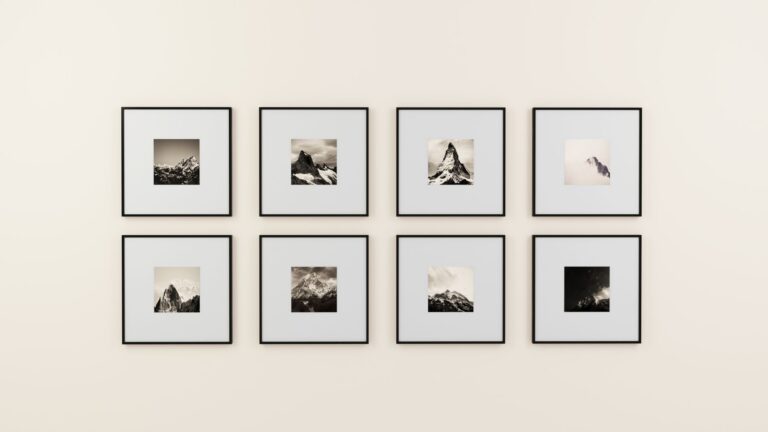
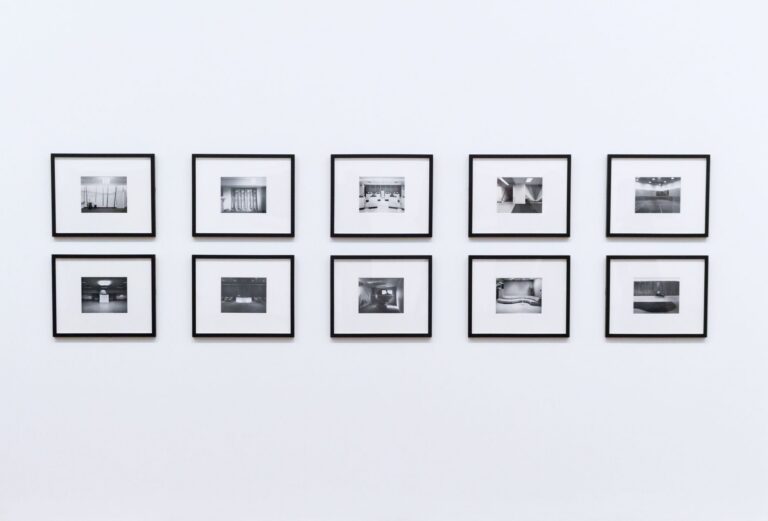
When you are hanging more than one frame together, measure the whole cluster as a single rectangle and center that rectangle at 60 inches, not each individual piece. I learned this the hard way with three prints over my desk. I centered each one at eye level separately and ended up with a staggered, seasick looking arrangement instead of a clean block.
- Lay the group out on the floor first and measure its total height and width.
- Find the vertical center of that full block and align it to the 60 inch mark.
- Keep spacing between frames consistent, usually 2 to 3 inches.
A note on ceiling height and room proportions
People with very tall ceilings sometimes want to hang art higher to fill the space, and I understand the instinct, but it usually backfires. A piece hung to eye level in a tall room still reads as intentional. A piece hung to match the ceiling reads like it is trying to disappear. If a wall genuinely feels bare above eye level art, add height with a taller piece or a vertical arrangement rather than raising the center point.
Hang for the person standing in the room, not for the wall.
The other place I see this rule ignored is stairways, and stairways deserve their own approach because eye level changes as you climb. There, I aim for the 60 inch mark relative to the midpoint of each step rather than the floor at the bottom, which keeps the line of frames roughly parallel to the stair rail instead of parallel to the floor.
Testing before you commit
Painter’s tape and paper cutouts save more walls than any level does. Cut kraft paper to the exact size of each frame, tape the cutouts up at your planned height, and live with them for a day or two before drilling anything. I do this every single time now, even for a single small print, because a mark on the wall photographs differently than it looks in person, and lighting changes how high or low something appears to sit.
Once the paper templates look right from the doorway, from the couch, and from wherever else you actually spend time in the room, transfer the measurements to the wall and hang the real piece. The extra ten minutes with tape has saved me from more patched nail holes than I can count.