This article may contain affiliate links. If you buy through them, Decorating Our Space may earn a small commission at no extra cost to you. Learn more.
A friend once asked me to help her pick ‘just a plain white’ for her hallway, certain it would take fifteen minutes. Three weekends later we had tested nine different whites on her wall and were still narrowing it down. Plain white, it turns out, is one of the more difficult colors to choose well, not because there aren’t enough options, but because there are too many, and most of them are not actually neutral.
There is no neutral white
Every white paint has an undertone, a faint trace of another color mixed in to keep it from looking flat or clinical. Some lean toward yellow, some toward pink, some toward blue or green. On the chip, in isolation, most whites look like plain white. Put two different whites next to each other and the undertones show up immediately, the way a slightly warm white can suddenly look almost beige beside a cooler one.
This is why picking a white from a single chip rarely works. You need at least two or three whites side by side to see what each one is actually doing. Alone, a white paint chip tells you very little. In comparison, it tells you almost everything.
How the undertone reveals itself
- Compare the white sample against a plain sheet of copy paper, which has almost no undertone of its own.
- Look at the sample in shadow, not just in direct light, since undertones often show up more clearly in dimmer conditions.
- Check it beside your trim, your ceiling, and any other white already in the room. Two different whites within sight of each other can look mismatched even though each one looks fine alone.
Light changes white more than any other color
White reflects almost all the light that hits it, which means it also reflects the color of that light more than a darker paint would. A white wall under warm bulbs will pick up a yellow cast. The same white under daylight-toned bulbs looks cooler and cleaner. A white wall near a lot of natural daylight will shift again, and a white wall that sits across from a brightly colored rug or piece of furniture can pick up a faint reflection of that color too.
I painted a bathroom a crisp white a few years ago, chosen under the store’s fluorescent lighting. At home, under the warm bulb in that bathroom’s single fixture, it read faintly yellow, almost like it needed cleaning even right after a fresh coat. The paint hadn’t changed. The light source had.
North versus south changes the same white
A white that looks clean and bright in a south-facing room, with strong warm light most of the day, can look flat and slightly gray in a north-facing room that only gets indirect light. This is the same pattern that shows up with any color, but it’s easier to miss with white because people assume white is immune to it. White has no color of its own to fall back on, so it borrows heavily from whatever light and undertone it’s given, more than a color that’s already saturated.
White isn’t the absence of color decisions. It’s where those decisions matter the most, because there’s nothing else in the paint to hide them.
What actually helped
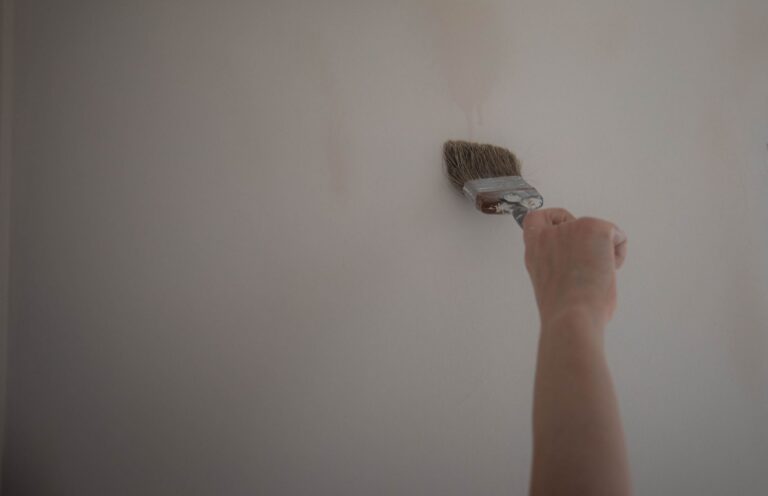
The method that worked for my friend’s hallway was simple, if slow. We painted three whites on separate boards, moved them through the hallway at different times of day, and held each one against her existing trim and floor. Two of the nine we’d started with were eliminated almost immediately, one clearly too yellow next to her trim, the other too cool and almost blue-gray in the hallway’s dim corner. The final choice took longer, but by the time we picked it, we’d actually seen it do what it would do on the wall for years, not just what it did on a chip for five seconds.
A shorter path, if you don’t have three weekends
Pick two or three candidates instead of nine. Test them in the room with the least natural light in your home, since that’s where undertones show up most clearly and where a wrong choice will bother you the most. If a white still looks clean and warm-enough in your dimmest room, it will almost certainly work everywhere brighter.
White isn’t harder because there’s something wrong with it. It’s harder because it shows its work. Every undertone, every light source, every neighboring color leaves a visible trace on a white wall that a bolder color would simply absorb.